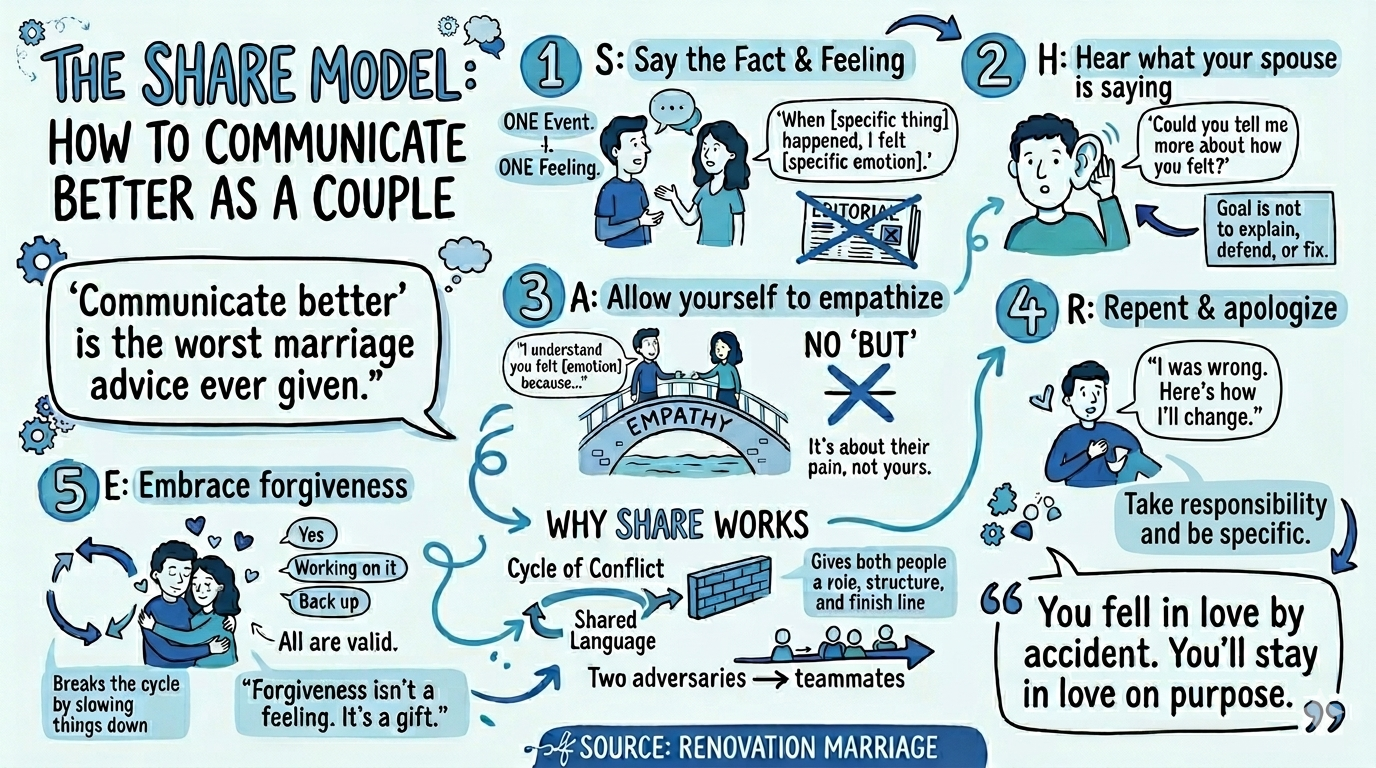
How to Communicate Better as a Couple: The SHARE Model
“Communicate better” is the worst marriage advice ever given.
Everyone says it. Every counselor. Every self-help book. Every well-meaning friend who’s never had to explain why the way their spouse loads the dishwasher feels like a personal attack.
The problem isn’t that you’re not communicating. You are communicating constantly. You’re communicating with your tone, your silence, your eye-rolls, and that exhale that somehow contains an entire paragraph of contempt. The problem is that the way you’re communicating is making everything worse.
You don’t need to talk more. You need a completely different way to talk.
After working with hundreds of couples, Erin and I developed a framework called the SHARE Model. It’s a five-step process for bringing up a hurt in a way that leads to healing instead of another fight. It’s simple enough to remember at 10 p.m. when tensions are high, and structured enough to keep a hard conversation from going off the rails.
We’ve watched couples use this model to resolve conflicts they’d been recycling for years. It doesn’t require a therapist or a personality transplant. It requires a willingness to try something different when the old way keeps producing the same result.
I’m going to walk you through how it works.

Why Your Current Approach Isn’t Working
Most couples have exactly two modes for handling hurt: explosion or avoidance. In explosion mode, someone brings up an issue and it immediately escalates into rehashing every offense since 2017. In avoidance mode, nobody says anything, and the resentment quietly grows underground like tree roots cracking a foundation.
There’s a reason for this. Most of us were never given a model for productive conflict. We saw our parents argue, and but we rarely saw it resolved well, if at all. The only playbook we got was whatever we absorbed by accident growing up.
Gottman’s research found that 69% of marital conflicts are perpetual. They never fully resolve because they’re rooted in personality differences. That means the goal was never to eliminate conflict. The goal is to talk about pain without creating more of it.
The couples who make it aren’t the ones who never fight. They’re the ones who learned how to fight without leaving casualties.
That’s what the SHARE Model is designed to do.
The SHARE Model: An Overview
SHARE is a five-step process where one spouse brings up a specific hurt and both partners work through it together. The person who was hurt leads Steps 1 and 5. The person who caused the hurt leads Steps 2 through 4. Both people have a clear role, a clear script, and a clear finish line.
Here’s how it works at a high level.
S: Say the Fact and How It Made You Feel
Proverbs 29:11 — “A fool gives full vent to his anger, but a wise man keeps himself under control.”
The person who was hurt starts with one sentence: “When [this specific thing] happened, I felt [this specific emotion].” That’s it. One event. One feeling. No editorializing, no “you always,” no bringing up last Thanksgiving.
This step is harder than it sounds. Most of us default to accusations (“You never listen to me”) instead of statements of fact and feeling. The sentence framework forces clarity. It tells your spouse exactly what happened and exactly how it landed, without burying the point under a pile of generalizations. Not sure what you're actually feeling? Start by identifying your top emotional needs. They're usually the key.
One event. One feeling. That’s where healing starts.
H: Hear What Your Spouse Is Saying
James 1:19 — “Everyone should be quick to listen, slow to speak, and slow to become angry.”
Now the other spouse steps in. Their only job is to listen, ask questions, and understand. “Could you tell me more about how you felt?” and “Why did that specific thing hurt so much?” are the kinds of questions that belong here.
The goal is not to explain, defend, or fix. The goal is to hear.
This is where most couples crash. The instinct when your spouse says you hurt them is to explain why you did it, defend your intentions, and launch into your side of the story. The SHARE Model asks you to resist that instinct completely. Hear first. Your turn to talk comes later.
A: Allow Yourself to Empathize
Romans 12:18 — “If it is possible, as far as it depends on you, live at peace with everyone.”
Empathy is the bridge between hearing and healing. This step asks the listener to put themselves in their spouse’s shoes and validate what they felt. “I understand you felt [emotion] because [reason].” Take each feeling one at a time. Don’t lump them together.
Two rules for this step. First, don’t say “but.” The moment you say “I understand, but...” you’ve stopped empathizing and started defending. Second, don’t redirect the conversation to how bad you feel about what happened. This step is about your spouse’s pain, not yours.
Empathy doesn’t mean you agree. It means you care enough to understand before you respond.
R: Repent and Apologize
Proverbs 28:13 — “He who conceals his sins does not prosper, but whoever confesses and renounces them finds mercy.”
This is where ownership happens. “I was wrong. I should not have [specific action].” Then: “I’m sorry I hurt you. I don’t ever want to hurt you that way again.” Then: “Here’s what I’m going to do to change.”
Be specific on that last one. Vague promises like “I’ll try harder” don’t rebuild trust, but specific commitments do. If you’re not sure what to change, ask your spouse what steps would help. Then ask the question that makes this step real: “Will you forgive me?”
And give them space to answer honestly. Forgiveness isn’t a reflex. It’s a decision, and it might take time.
E: Embrace Forgiveness
Colossians 3:13 — “Bear with each other and forgive whatever grievances you may have against one another. Forgive as the Lord forgave you.”
The person who was hurt now has three options. Option 1: “Yes, I forgive you.” Option 2: “I’m not there yet, but I will actively work toward forgiveness.” Option 3: “Let’s back up. I don’t think we’re on this step yet.” All three are valid. None of them are failure.
When forgiveness is offered, seal it with something physical: a hug, a prayer, a moment that marks the transition. This isn’t sentimental fluff. It’s closure that tells both your brains this conversation ended differently than all the ones before it.
Forgiveness isn’t a feeling. It’s a gift you give yourself as much as your spouse.
What SHARE Sounds Like in Real Life
Theory is great. Knowing what it sounds like at your kitchen table is better. Here’s a simplified version of SHARE in action.
Let’s say your spouse forgot something important to you. Maybe they missed your kid’s game after promising they’d be there. Here’s how the conversation changes with SHARE.
Without SHARE: “You never show up for this family. I don’t even know why I bother asking anymore. You always say you’ll be there and you never are.” This triggers defensiveness, counter-complaints, and a fight about something that happened in 2019.
With SHARE: “When you didn’t come to the game after saying you would, I felt unimportant and alone.” The other spouse responds: “Tell me more about what that felt like.” Then: “I understand you felt unimportant because my actions said the game didn’t matter, which made you feel like you didn’t matter.” Then: “I was wrong. I’m sorry. Here’s what I’m going to do differently.”
Same issue. Completely different conversation. The first version attacks a person. The second addresses a pain. One leads to a wall. The other opens a door.
The SHARE Model doesn’t change what happened. It changes what happens next.
Why This Works When Other Approaches Don’t
The SHARE Model works because it gives both people a role, a structure, and a finish line. Most couples fight in circles because there’s no process. They bring up a hurt, the other person gets defensive, it escalates, somebody shuts down, and nothing gets resolved. Two weeks later, the same fight starts again with fresh ammunition.
SHARE breaks the cycle by slowing things down and assigning clear responsibilities. The person sharing knows exactly how to bring up the hurt. The person listening knows exactly what’s expected. And both people know where the conversation is headed: toward empathy, ownership, and when the time is right, forgiveness.
Once you learn this framework, you and your spouse have a shared language. When something hurts, instead of bracing for a fight, you can say, “Can we SHARE about this?” And you both know exactly what that means.
A shared framework turns two adversaries back into teammates.
One Important Caveat
The SHARE Model is a communication tool, not a cure-all. It works beautifully for the everyday hurts and recurring conflicts that erode marriages over time. It is not designed for situations involving abuse, active addiction, or trauma that requires specialized professional treatment. If you’re in a dangerous situation, please seek help from a qualified professional first.
Your Next Step
If you want to try SHARE tonight: Start with something small. Not your biggest, most loaded issue. Pick a recent, specific hurt, use the “When this happened, I felt this” sentence, and see what happens when you follow the steps. You’ll be surprised how different a conversation feels when both people know the rules.
If your marriage needs more than a framework on a blog: Look into our weekend marriage retreat. The SHARE Model is one of several tools we teach, and you’ll spend time practicing it on real issues with a trained coach available. 98% of couples who attend report significant progress. Many of them arrived not speaking to each other.
You fell in love by accident. You’ll stay in love on purpose.