7 Warning Signs Your Marriage Is in Trouble
Fighting isn't killing your marriage. This is.
After working with hundreds of couples, I've seen what actually destroys marriages. It's not the big explosion. It's the slow drift no one notices until it's almost too late.
Nobody’s marriage falls apart in a single afternoon.
It’s not like you wake up one Tuesday and think, “Well, we were great yesterday, but today it’s all over.” That’s not how it works. Marriage doesn’t shatter like a window. It erodes like a shoreline: slowly, quietly, one wave at a time, until the day you look up and realize you’re standing on ground that used to be solid.
The key is catching the warning signs early enough to do something about them. Because here’s the thing about shoreline erosion: if you notice it soon enough, you can reinforce the ground. Wait too long, and you’re standing in the ocean wondering where your yard went.
Here are 7 warning signs your marriage is in trouble – and exactly what to do about each one.
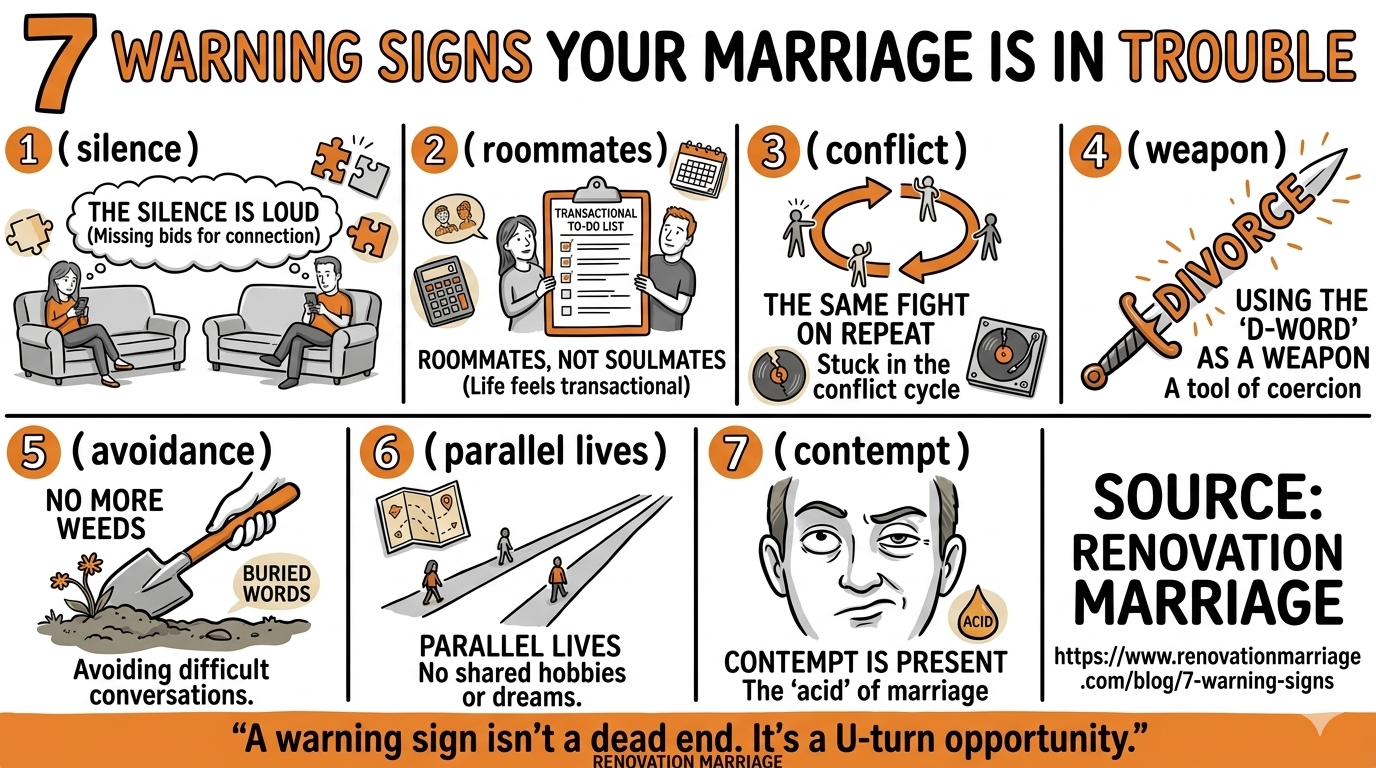
Sign #1: You’ve Stopped Talking About Anything That Matters
You still talk. You coordinate schedules, discuss who’s picking up the kids, negotiate what’s for dinner. You are brilliant logistics partners. But somewhere along the way, the conversations that used to go until 2 a.m. The ones about dreams and fears and “what if we just moved to Montana and started a llama farm.” Those stopped.
You can share an address and still be miles apart.
This is often the first sign of what we call the Disappointment stage. The honeymoon shimmer has worn off, the differences that seemed cute are now just irritating, and you’ve quietly concluded that conversation about the deeper issues requires more energy than you have left at 9 p.m. Often couples stop talking because their emotional needs have gone unmet for so long they've given up asking.
The research backs this up: Dr. John Gottman’s lab found that couples in thriving marriages spend at least a few minutes every day in what he calls a “stress-reducing conversation” – not about the relationship, just about life. Couples heading for divorce? They stopped having those conversations at some point.
✅ What to do about it: Start a daily 15-minute check-in. Instead of talking logistics, just talk about life. Ask one real question like: “What’s weighing on you right now?” or “What was the best and worst part of your day?” Then listen. Actually listen. No fixing, no advice, no glancing at your phone. Fifteen minutes. That’s 1% of your day to invest in the most important relationship of your life.
Sign #2: Contempt Has Replaced Respect
There’s a difference between being annoyed with your spouse and looking down on them. Annoyance says, “That thing you did frustrated me.” Contempt says, “You’re so frustrating.”
Contempt in a relationship shows up as eye-rolling, sarcasm, name-calling, mockery, and that tone of voice that could curdle milk. It’s the dismissive snort when your spouse shares an idea. It’s the “Well, what did you expect?” when they make a mistake. It’s the way you talk about them to your friends, as if they’re a project that didn’t turn out.
Contempt is criticism with a sneer. It doesn’t just say: “you’re wrong.” It says: “you’re beneath me.”
The research backs this up: Of all the destructive patterns Gottman studied across thousands of couples over four decades, contempt was the single greatest predictor of divorce. Not infidelity. Not incompatibility. Showing contempt. The eye-roll is more dangerous than the affair.
This sign typically appears during the Discouragement stage. You’ve been disappointed for a while, you’ve tried to change your spouse and it didn’t work, and now frustration has curdled into something uglier. You’re no longer fighting for the relationship – you’re fighting against each other. You've tried to change your spouse and it didn't work, so now you're wondering whether a narcissist can really change.
✅ What to do about it: Contempt grows in the soil of unspoken resentment. The antidote is building a culture of appreciation. This week, tell your spouse one specific thing you appreciate about them every day. Instead of generic (“you’re so great”), be specific (“The way you handled that conversation with our son last night showed a lot of patience”). Gottman’s research shows that couples who maintain a 5-to-1 ratio of positive to negative interactions are dramatically more likely to stay together. You can’t get to 5:1 if you’re starting every day below 0.
Sign #3: You’re Living as Roommates, Not Partners
You share a mortgage, a Netflix password, and a refrigerator. You divide the chores with the efficiency of a Fortune 500 supply chain. You are, by every measurable standard, excellent co-habitants.
You are also lonely.
A hotel room has everything a home has. Bed. Bathroom. Roof. Climate control. There's even art on the walls – you know, those paintings that are specifically chosen to offend no one and inspire no one.
You can stay there for weeks. You can hang your clothes in the closet. But here's the thing: you could check out tomorrow and leave no trace. No one would know you'd been there.
It's shelter. It's functional. But it's not home. It’s missing something.
Some marriages have all the components of a partnership and none of the components of a romance. Their relationship has become a hotel room. It’s missing something.
The roommate stage is the hallway between Discouragement and Despair. You’re not actively hostile. That would require too much energy. Instead, you’ve settled into a kind of emotional ceasefire where nobody’s fighting because nobody’s engaging. It’s peaceful in the way an empty house is peaceful.
✅ What to do about it: Do one thing this week that has nothing to do with logistics and everything to do with connection. This isn’t a “we should really talk about our marriage” conversation. That can wait. Something fun. Something that reminds you both there’s a human being across the table, not just a co-manager. Cook a meal together. Take a walk after dinner. Try the 6-Second Kiss before someone leaves for work. (Yes, it’s awkward at first. That’s how you know it’s working.)
Sign #4: You Avoid Conflict at All Costs – or It Explodes Every Time
Healthy marriages aren’t conflict-free. They’re conflict-capable. The couples who make it aren’t the ones who never fight: they’re the ones who’ve learned to fight without leaving casualties.
Most struggling couples fall into one of two ditches. In the first ditch, you avoid conflict entirely. Someone brings up a hard topic and the other person changes the subject, leaves the room, or deploys the passive aggressive classic “I’m fine” – which, as everyone knows, is the least fine word in the English language. In the second ditch, every disagreement becomes a cage match. Somebody mentions the dishes and somehow you’re relitigating a comment from last Thanksgiving.
If your only two settings are silence and explosion, your marriage is missing a thermostat.
The research backs this up: Gottman’s research revealed that 69% of marital conflicts are perpetual. They never fully resolve because they’re rooted in fundamental personality differences. The goal isn’t to eliminate conflict. It’s to learn to have conflict without damaging each other in the process.
Avoidance is a classic feature of the Discouragement and Despair stages. You’ve tried talking and it went badly so many times that silence feels safer. But silence doesn’t mean the problem went away. It means the problem went underground, where it’s growing roots.
✅ What to do about it: Start with this framework: “When [this specific thing] happened, I felt [this specific emotion].” One event. One feeling. No “you always” or “you never.” This is the first step of the SHARE Model, a communication process Erin and I developed to help couples talk about hurt in a way that leads to healing instead of more damage. We’ll unpack the full model in a future article, but this sentence alone will change the temperature of your next difficult conversation.
Sign #5: Physical Intimacy Has Disappeared (or Become Mechanical)
I’m not just talking about sex – though yes, that too. I’m talking about touch. The hand on the shoulder as you pass in the kitchen. The hug that lasts longer than the one you give your coworker at the holiday party. The kind of physical closeness that says, “You’re not just someone I live with. You’re someone I want to be near.”
When emotional intimacy erodes, physical intimacy follows. It’s almost impossible to want to be physically close to someone you feel emotionally distant from. And when physical intimacy disappears, the emotional distance accelerates. It’s a cycle that feeds itself.
Intimacy doesn’t disappear because of a lack of desire. It disappears because of a lack of emotional connection.
This sign often straddles the Despair and Disconnection stages. One or both partners have pulled so far back emotionally that physical closeness feels forced, obligatory, or even threatening. The bedroom becomes another room you share rather than a place you connect.
✅ What to do about it: Don’t start with sex. Start with non-sexual touch. Hold hands in the car. Sit on the same couch instead of retreating to your separate corners. Hug for six seconds when you see each other at the end of the day (sound familiar?). Physical touch releases oxytocin, which lowers cortisol and builds trust at a neurochemical level. You’re literally rewiring your brain toward connection. If the emotional distance runs deep, this is one of many reasons a concentrated marriage intensive can help – you need hours, not minutes, to rebuild what eroded over years.
Sign #6: You Fantasize About Life Without Your Spouse
This isn’t the dramatic, soap-opera kind of fantasizing. The quiet kind. The kind where you’re sitting in traffic and catch yourself thinking, “What would my life look like if I just... didn’t go home?” The kind where you start noticing apartments for rent. The kind where you mentally calculate whether you could afford to live on your own.
Or maybe it’s not about leaving. Maybe it’s about someone else. A coworker who actually laughs at your jokes. An old friend who slid into your DMs. Someone who makes you feel like you matter again, because you haven’t felt that at home in a long time.
When you start looking for the exit, it’s a sign you’ve stopped believing the room can change.
This is deep in the Despair stage, approaching Disconnection. The sadness and frustration are giving way to something more dangerous: indifference.
✅ What to do about it: First, be honest with yourself about what’s happening. Fantasy thrives in secrecy. If you’ve been mentally building an escape plan, that’s important information – not because it means your marriage is over, but because it means your marriage is starving for something it’s not getting. Name what’s missing: respect? affection? feeling valued? Then ask yourself whether you’ve told your spouse what you need. If the thought of having that conversation feels impossible, that’s a strong signal you need outside help: a counselor, a pastor, or a marriage intensive where you’ll have the time and structure to go deep.
Sign #7: You Feel Nothing
This is the one that scares me the most. It isn’t dramatic and loud. It’s quiet, and that’s what makes it so dangerous.
Anger is loud. Sadness is visible. But apathy? Apathy is a flatline. And flatlines don’t call for help.
In counseling, this stage sounds like: “I love him, but I’m not in love with him.” Or: “I don’t hate her. I just... don’t feel anything.” The opposite of love isn’t hate. Hate still has energy. Hate still cares enough to be angry. The opposite of love is indifference, and indifference is the final stage of disconnection. Sometimes the numbness started as something much hotter.If what you're feeling is closer to hatred than indifference, start here.
As long as you're fighting, you're still in the ring. Indifference is when you forfeit. You didn’t lose the battle; you just stopped showing up.
This is Stage 5: Disconnection. One or both partners have lost all emotional attachment. The resentment that used to burn hot has cooled to ash. You’re not fighting anymore – not because you resolved anything, but because you’ve stopped caring enough to fight. You coexist. You tolerate. And somewhere in the back of your mind, you’re deciding between two options: live as roommates for the rest of your life, or leave.
If this is you, I want to be honest: I’m not going to pretend a listicle is going to fix this. A 15-minute check-in and a 6-second kiss are not enough when you’re at Stage 5. You need something more. But I also want to tell you something with everything I’ve got:
It’s not too late.
The research backs this up: A landmark study tracked couples who described themselves as “very unhappy” in their marriages. Of those who simply didn’t give up – who stuck it out even when they wanted to quit – 80% described themselves as “very happily married” five years later. Eighty percent. Sometimes the only difference between a marriage that makes it and one that doesn’t is not giving up.
✅ What to do about it: Get intensive help. A weekly appointment that gives you one hour per week to untangle years of disconnection isn’t enough. You need something concentrated, immersive, and structured – a marriage intensive where you can spend an entire weekend breaking through the walls that hourly sessions can’t reach. At Renovation Marriage, about 75% of the couples who attend are in some level of crisis. Many are at Stage 5. And we’ve watched hundreds of them walk out on Sunday holding hands, after walking in on Friday barely speaking. It is not too late. If you're already thinking about divorce, here's why 48 hours could change your mind.Here's how to decide between weekly counseling and a marriage intensive for your situation.
Which Sign Did You Recognize?
Maybe you saw yourself in one of these. Maybe you’re reading this with one eye and checking your spouse’s reaction with the other.
Here’s what I want you to take away: recognizing the warning signs is not a diagnosis of failure. Every marriage drifts through some of these stages. The five stages of growing apart – Desire, Disappointment, Discouragement, Despair, Disconnection – aren’t a death sentence. They’re a map. And once you know where you are on the map, you can choose a different direction.
Remember: the drift is normal, but the drift is not your destiny.
Your Next Step
If you’re in Signs 1–3: Start with the action steps above. You have time, and small changes in daily habits can reverse early-stage drift faster than you’d expect. Subscribe to this blog – next week we’re going deep on what the Bible says about restoring a broken marriage.
If you’re in Signs 4–5: Consider learning the SHARE Model (coming soon on this blog), and seriously look into a marriage intensive. You need more than tips – you need tools, and you need time to practice them.
If you’re in Signs 6–7: Please don’t wait. Explore our weekend marriage retreat. It’s affordable ($500 per couple), it’s led by people who’ve been where you are, and it works. We’ve seen hundreds of couples reverse Stage 5 disconnection in a single weekend. You could be next. We walk through all 5 stages of drifting apart in detail here, including how to tell which one you’re standing in. What happens at a marriage intensive.
And no matter where you are: the fact that you read this far means something is still alive in you that wants this marriage to work. That spark? It’s enough. It’s more than enough. It’s the beginning.
You fell in love by accident. You’ll stay in love on purpose. And today is a really good day to start being purposeful.